
Optimizing for Multimodal Search: The New Era of AI SEO
Obsah článku
- What Multimodal Search Actually Looks Like
- How Multimodal Search Systems Actually „Read“ Your Content
- Why Keywords Alone Don’t Cut It Anymore
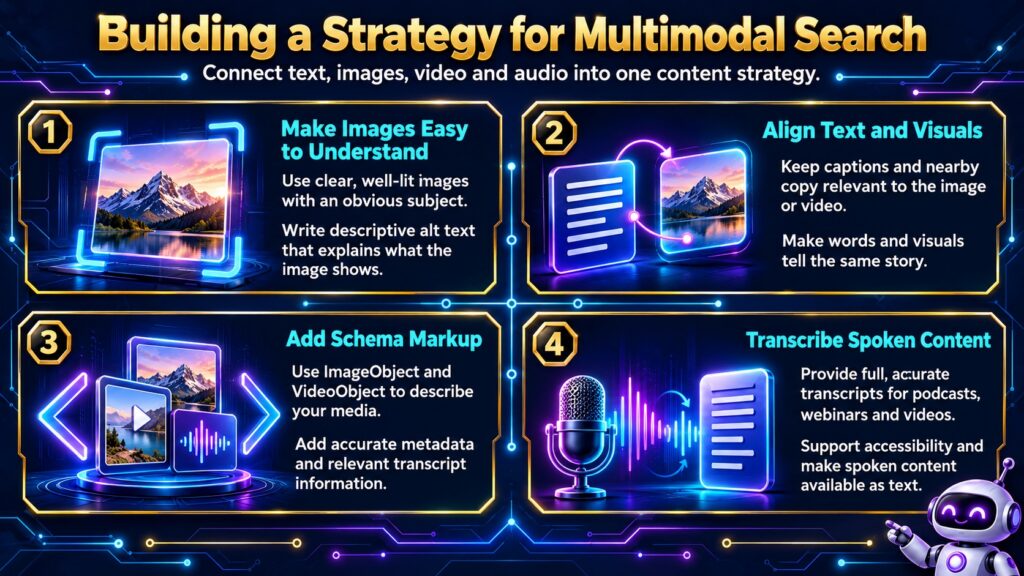
- Building a Strategy for Multimodal Search
- 1. Make Your Images Easy for Machines to Understand
- 2. Keep Your Text and Your Visuals Telling the Same Story
- 3. Add Schema Markup So Engines Don’t Have to Guess
- 4. Transcribe Everything Spoken
- Turning Flat Content Into a Real Multi-Format Experience
Search isn’t just typing words into a box anymore. Multimodal search lets people take a photo, ask a question out loud, or mix a picture with typed text to find what they need. If you’re working on content strategy in 2026, this matters. Ignore it, and your content quietly stops showing up where people are actually looking.
What Multimodal Search Actually Looks Like
This type of search lets someone use more than one input at a time — a photo plus a question, a voice note plus an image, or a video frame matched against a huge library of visuals. Google Lens helped make this normal: point your camera at something, and you instantly get related products, articles, or explanations. Multisearch took it further, letting people snap a picture and add a bit of text on top, like „show me this in blue“ or „where can I find this nearby.“
Then came AI Overviews, which pull together text, images, and structured data into one answer instead of a list of links. What this means for your website: it’s no longer judged only on its words. Images, video, audio, even how a page is laid out — all of it now affects whether you get found.
How Multimodal Search Systems Actually „Read“ Your Content
An AI engine doesn’t look at a picture the way a human does. It uses computer vision to see objects, text, colors, and how things are arranged, then checks that against the words sitting nearby. Take a photo of a hiking boot on a product page. The system doesn’t just look at the boot — it reads the description next to it too. If the text mentions waterproofing and the photo shows mud, it connects the two and treats that as a strong signal the page is genuinely about hiking boots.
Video and audio work similarly. Speech gets converted to text, scenes get detected, and everything feeds into a model trying to figure out what the content is really about.
Why Keywords Alone Don’t Cut It Anymore
Ranking used to be about matching search terms as closely as possible. That’s changing. Search engines now lean more on real people, places, products, ideas — and how they connect, rather than exact word matches. A page about a specific trail doesn’t need „hiking trail“ repeated ten times if it clearly covers the location, difficulty, elevation, and what’s nearby.
This is exactly why multimodal search favors content built on real context, not repeated phrases. Engines are getting better at figuring out what a page covers just from the mix of text, images, and markup — so density matters less than giving a full, honest picture of the topic.
Building a Strategy for Multimodal Search
None of this means overhauling your entire site. It means treating text, images, video, and audio as pieces of the same puzzle, instead of separate tasks handled by separate people.
1. Make Your Images Easy for Machines to Understand
A blurry or generic photo doesn’t give computer vision much to work with. Clear, well-lit images with an obvious subject are much easier to read correctly. Alt text matters too — skip vague labels like „shoe1.jpg“ and describe what’s actually in the image, the way you’d explain it to someone over the phone. This one habit alone makes a bigger difference than most people expect.
2. Keep Your Text and Your Visuals Telling the Same Story
An image rarely stands alone as far as a search engine is concerned — it gets interpreted through whatever text sits around it. Captions and body copy near a photo or video should actually describe what’s in it, not sit disconnected somewhere else on the page. When the words and the visuals line up, engines can classify the page with much more confidence.
3. Add Schema Markup So Engines Don’t Have to Guess
Structured data spells things out instead of leaving engines to infer. Schema types like ImageObject and VideoObject let you specify format, duration, resolution, even a link to a transcript, right in the code. This gives multimodal systems a clean, direct source of information to pull from when building an AI-generated answer.
4. Transcribe Everything Spoken
If it’s not written down, it’s often invisible to search engines. A podcast, webinar, or demo video needs a full, accurate transcript — not just a short summary. This helps accessibility too, and it gives engines a complete text layer to match against the audio and visuals.
Turning Flat Content Into a Real Multi-Format Experience
The sites that do well going forward won’t treat text, images, and video as separate jobs for separate teams. They’ll build them around the same topic, working together. A strong product page might have a clear written description, a well-labeled photo, a short video with a transcript, and schema markup tying it all together — each part backing up the others instead of just repeating them.
This mirrors how people actually search now. They might start with a photo, add a typed question, then watch a short clip before deciding anything. Content stuck in a single format just can’t keep up with that anymore.
Multimodal search isn’t a passing trend — it’s a real shift in how relevance gets decided online. If you invest in readable visuals, aligned text, solid schema markup, and full transcripts, you’re set up for a search landscape increasingly run by AI Overviews and visual search. Skip it, and you risk disappearing from exactly the places your audience is looking.

Zakladateľ agentúry Market. Brand. Grow. Taktiky, o ktorých píšem, najprv testujem na vlastných projektoch, od účtu so 450 000 sledovateľmi po web zo 4. strany Google na prvú.
Všetky články autora →Súvisiace články
What Is a Pillar Page? The Ultimate Guide to Topic Clusters & SEO
Obsah článkuBreaking Down What a Pillar Page Actually DoesHow a Pillar Page Relates to Its Cluster ArticlesWhy This Approach Matters for Search…
26. 10. 2026 · Peter Terlanda
Google Knowledge Graph SEO: The Complete Guide to Entity Optimization
Obsah článkuUnderstanding Google Entities and Knowledge Panels How Semantic Search Drives Knowledge Graph SEO Why Entity Recognition Builds Search Engine Trust 5 Practical Steps to…
19. 10. 2026 · Peter Terlanda
Meta AI SEO: Optimizing Content for Facebook and Instagram’s Answer Engine
Obsah článkuHow Meta AI Finds and Uses InformationSearch Engines and Meta AI SEOPractical Meta AI SEO TacticsPut the Main Answer FirstKeep Your…
12. 10. 2026 · Peter Terlanda Bezplatná konzultácia
Radšej by ste to nechali na odborníka?
15 minút s autorom článku, prejdeme váš web a odídete s konkrétnymi návrhmi. Bez záväzku.
Chcem bezplatnú konzultáciu →