Meta AI SEO: Optimizing Content for Facebook and Instagram’s Answer Engine
Obsah článku
- How Meta AI Finds and Uses Information
- Search Engines and Meta AI SEO
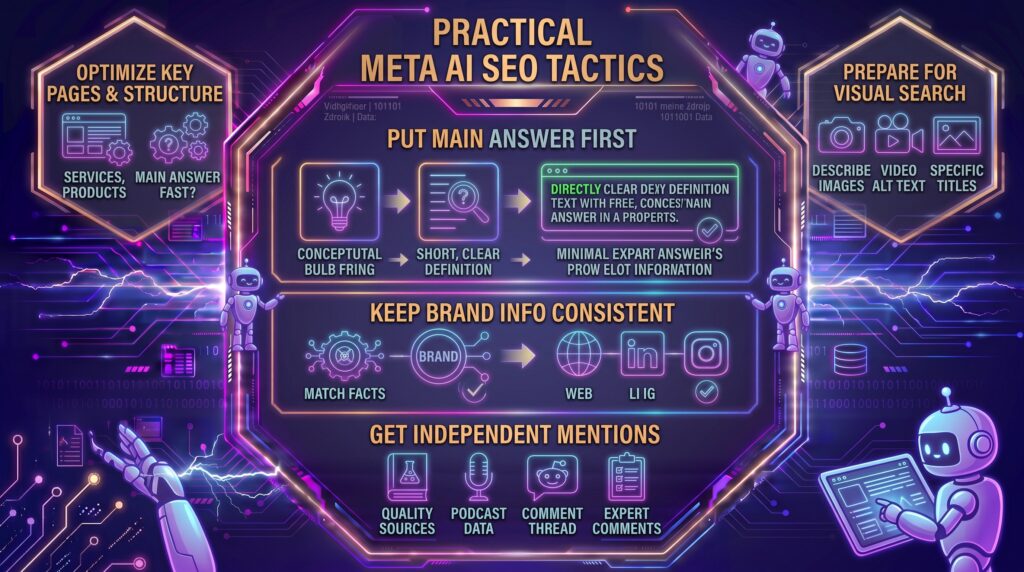
- Practical Meta AI SEO Tactics
- Put the Main Answer First
- Keep Your Brand Information Consistent
- Get Mentioned on Independent Websites
- Prepare for Visual Search
- Make Your Brand Easy to Find in Conversations
- How to Measure Meta AI SEO Results
- Conclusion: Meta AI SEO
Meta AI SEO is changing how brands can get discovered on Facebook and Instagram. Users no longer need to type a few keywords and browse ten search results. They can ask Meta AI a complete question, compare products, look for recommendations, or ask for a quick explanation.
That changes the content game.
Traditional SEO still matters.Keyword targeting alone is not enough though. Your content needs to give AI clear facts they can understand and use. Short answers. Strong context. Consistent brand information.
How Meta AI Finds and Uses Information
When users ask Meta AI a question, the system can draw on information from the conversation, public content, social platforms, and web sources. The exact sources can vary depending on the query and how Meta updates its technology
For brands, the practical lesson is simple. Make important information easy to find.
If your website says, “We deliver innovative solutions for modern businesses,” it tells AI very little.
Try this instead:
“We provide payroll software for small businesses in the UK.”
Now the service, audience, and market are clear.
Use the same approach across your website. Your service pages should explain exactly what you offer. Product pages should name the product and its main use. Your About page should clearly identify the company, location, expertise, and target market.
Skip the vague marketing language.

Search Engines and Meta AI SEO
Do not assume every Meta AI answer comes directly from Google or Bing. AI products can use different search systems, indexes, partnerships, and data sources, and these can change.
You should still care about traditional search engines. Good technical SEO helps search engines crawl your website, while strong content gives retrieval systems useful information.
Focus on the basics. Descriptive titles, logical URLs, internal links, useful pages, and original information.
Build for the web, not one platform.
Practical Meta AI SEO Tactics
You do not need to rewrite your entire website. Start with your most important pages: services, products, guides, comparisons, and high-performing articles.
Then ask one question:
“Can someone find the main answer quickly?”
If not, change the structure.
Put the Main Answer First
If you explain a concept, give the definition immediately.
Then explain how it works, what your product offers and who needs it.
This format helps both readers and AI. Nobody wants to read through 400 words to find one basic fact.
Keep important answers short. Add detail underneath.
Keep Your Brand Information Consistent
Your website might describe you as a “B2B analytics platform,” while LinkedIn calls you a “business intelligence company” and Instagram says you are a “data insights brand.”
That creates unnecessary confusion.
You do not need identical wording on every platform. The facts should match.
Keep your company name, product names, locations, services, and key descriptions consistent in your website and social profiles. Update information when your business changes.
The same applies to founders, experts, and other important people connected to your brand.
Keep the facts straight.
Get Mentioned on Independent Websites
Your own website tells people who you are. Independent sources can support that information.
Relevant industry publications, interviews, podcasts, and genuine Reddit discussions can all contribute to your online presence.
Quality matters more than quantity.
Instead of creating a lot of weak backlinks, publish something that’s worth referencing. Release original research. Share industry data. Give expert comments to journalists. Publish useful benchmarks.
For example, a property company could publish rental price data for 20 cities. A software company could survey 500 IT managers.
That gives other websites something concrete to discuss.
Prepare for Visual Search
Meta’s platforms rely heavily on images and video, so your Meta AI SEO strategy should not focus only on written content.
Describe important images accurately. Use useful alternative text. Give videos specific titles and descriptions.
Instead of:
“Watch our latest video!”
Try:
“See how our accounting software creates a monthly expense report in under two minutes.”
That sentence gives both users and AI systems context.
The same principle applies to Instagram posts and Reels. The image catches attention. The supporting text explains what people are looking at.
Make Your Brand Easy to Find in Conversations
People often start AI searches with a problem, not a company name.
They might ask:
“Which CRM is best for a 10-person sales team?”
“Which agency handles SEO for SaaS companies?”
“What’s the best accounting software for freelancers?”
Your brand needs a clear answer to three basic questions:
What do you sell?
Who is it for?
What problem does it solve?
A SaaS company that says, “We help businesses grow through innovative technology,” gives AI almost nothing.
“We provide CRM software for small sales teams” works much better.
Specificity wins.
Your social content should reinforce that positioning. Answer customer questions. Show products in use. Explain common problems. Share real examples.
Your sales team’s questions are often a great content source.
How to Measure Meta AI SEO Results
AI-driven traffic can be difficult to track. Someone may discover your company through an AI answer, remember the name, and visit your website later by typing the URL directly.
So do not rely on referral traffic alone.
Track visits from Meta properties, branded searches, direct traffic, social engagement, and mentions on external websites.
You can also test relevant AI prompts regularly.
For example:
- Which SEO agency works with SaaS companies?
- What accounting software is the best for freelancers?
- Which CRM works well for small sales teams?
Record which companies appear and whether the information about your brand is correct.
Repeat the tests every few weeks. Results can change as AI systems update their data and retrieval methods.
Conclusion: Meta AI SEO
Meta AI SEO does not require a secret formula. It requires better information.
Give direct answers. Keep your company details consistent. Explain your products clearly. Earn credible third-party mentions. Add context to images and videos.
And remove the fluff.
If you sell payroll software, say it. If you work with restaurants, name them. If your product solves a specific problem, explain how.
AI systems cannot confidently recommend what they cannot clearly identify.
Clear beats clever.
Specific beats vague.
Useful content wins.

Zakladateľ agentúry Market. Brand. Grow. Taktiky, o ktorých píšem, najprv testujem na vlastných projektoch, od účtu so 450 000 sledovateľmi po web zo 4. strany Google na prvú.
Všetky články autora →Súvisiace články
Optimizing for Multimodal Search: The New Era of AI SEO
Obsah článkuWhat Multimodal Search Actually Looks LikeHow Multimodal Search Systems Actually „Read“ Your ContentWhy Keywords Alone Don’t Cut It AnymoreBuilding a Strategy…
2. 11. 2026 · Peter Terlanda
What Is a Pillar Page? The Ultimate Guide to Topic Clusters & SEO
Obsah článkuBreaking Down What a Pillar Page Actually DoesHow a Pillar Page Relates to Its Cluster ArticlesWhy This Approach Matters for Search…
26. 10. 2026 · Peter Terlanda
Google Knowledge Graph SEO: The Complete Guide to Entity Optimization
Obsah článkuUnderstanding Google Entities and Knowledge Panels How Semantic Search Drives Knowledge Graph SEO Why Entity Recognition Builds Search Engine Trust 5 Practical Steps to…
19. 10. 2026 · Peter Terlanda Bezplatná konzultácia
Radšej by ste to nechali na odborníka?
15 minút s autorom článku, prejdeme váš web a odídete s konkrétnymi návrhmi. Bez záväzku.
Chcem bezplatnú konzultáciu →