
What Is a Pillar Page? The Ultimate Guide to Topic Clusters & SEO
Obsah článku
- Breaking Down What a Pillar Page Actually Does
- How a Pillar Page Relates to Its Cluster Articles
- Why This Approach Matters for Search Rankings and Trust
- Three Formats You Can Choose When Building One
- 1. The „10x Content“ Approach
- 2. The Curated Resource Hub
- 3. The Ultimate Guide Format
- Building Your Own Hub Page From Scratch
- Start by Separating Broad Themes From Narrow Questions
- Match Your Content to Real Search Intent
- Make It Easy to Navigate and Skim
- Connect Everything With a Strong Internal Linking Strategy
- Real Examples Worth Studying Before You Start
- Final Thoughts
A pillar page is one in-depth page that covers a broad topic and links out to smaller, more focused articles on the same subject. Instead of publishing random blog posts that don’t really connect to anything, you build one central hub.
Breaking Down What a Pillar Page Actually Does
A pillar page covers a topic broadly, but it still has to go deep enough to actually be useful. It shouldn’t read like a thin overview padded with keywords — the goal is to make it the kind of resource people bookmark and actually come back to.
Topic clusters are what surround this kind of page. Think of a wheel: the pillar page sits at the hub, and the cluster articles are the spokes branching out from it. Say you run a coffee website — your hub page might be called „The Complete Guide to Brewing Coffee at Home,“ and from there you’d have smaller articles on grind size, water temperature and brewing methods. Put together, this kind of structure shows search engines and real readers that the site knows what it’s talking about.
How a Pillar Page Relates to Its Cluster Articles
The hub page is supposed to stay broad. It touches on every major subtopic without going too deep into any one of them — its real job is just to point readers toward more detailed content elsewhere on the site.
Cluster articles do the opposite. Each one digs into a single, specific question. These two formats aren’t competing with each other; they’re meant to work as a pair. If your hub page starts repeating what the cluster articles already say, that can hurt both pages‘ rankings, since search engines get confused about which page should rank for what. Keep the roles separate and the whole thing works a lot better.
Why This Approach Matters for Search Rankings and Trust
Search engines have gotten a lot better at telling shallow content apart from stuff that’s actually deep and well-researched. That’s part of why a pillar page has become such a big deal in SEO circles. Google tends to favor sites that show real expertise on a subject, not sites publishing scattered posts that are each chasing one keyword.
A well-built hub page, backed by solid cluster content, builds that kind of trust almost on its own. Internal links between the hub and its articles spread authority across the site and tend to keep visitors reading longer. There’s a practical upside for readers too — landing on the hub gives them context right away, instead of dropping them on a narrow article that only answers part of what they came looking for.
Three Formats You Can Choose When Building One
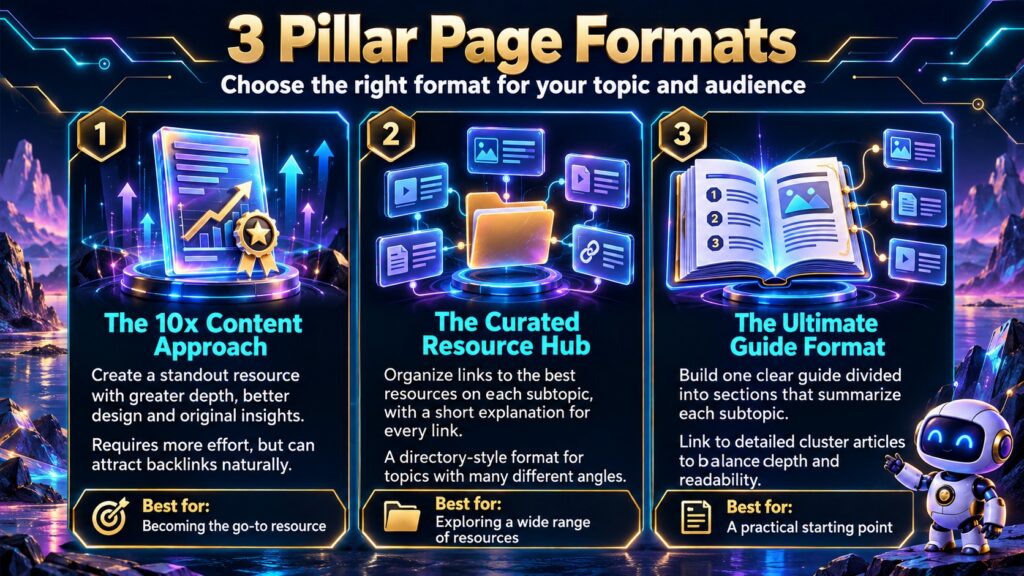
Not every pillar page looks the same, and honestly, the right format really just depends on your topic and how people search for it.
1. The „10x Content“ Approach
This version tries to be noticeably better than anything else currently ranking for the topic — more thorough, better designed, sometimes backed by original data that competitors haven’t bothered to gather. It takes more time to put together, but it tends to earn backlinks on its own because it becomes the thing people point to.
2. The Curated Resource Hub
This one works more like a directory than a story. It links out to the best resources on each subtopic, with a short line of context next to each link. Works well for topics that have a lot of different angles that wouldn’t flow naturally as one continuous piece.
3. The Ultimate Guide Format
This is probably the type you’ll run into most often. It reads as one clear guide split into sections, and each section summarizes a subtopic while linking off to a more detailed cluster article. It strikes a decent balance between depth and readability, which is why it’s usually the safest place to start.
Building Your Own Hub Page From Scratch
None of this is especially complicated, but it does help to plan a bit before you sit down and start writing.
Start by Separating Broad Themes From Narrow Questions
Start with the broad topics your site genuinely has some authority on — those are your hub page candidates. Then, under each one, list out the narrower questions people are actually typing into search bars. Those become your cluster topics. Go too narrow with your main topic and you’ll run out of subtopics fast; go too broad and the page turns into a mess.
Match Your Content to Real Search Intent
Once you’ve got your core topics down, look at what people are actually searching for around them. Group those searches by intent — are they trying to learn something, compare their options, or are they ready to buy? That tells you roughly how comprehensive your hub page needs to be.
Make It Easy to Navigate and Skim
Since these pages tend to run long, good navigation matters more than people give it credit for. A table of contents near the top, clear headings, some room to breathe visually — all of that helps readers find what they need without endless scrolling. Pages that are easy to get around tend to hold people’s attention longer, and that extra time on page usually helps with rankings too.
Connect Everything With a Strong Internal Linking Strategy
Every cluster article should link back to the hub, and the hub should link out to each one using clear, descriptive anchor text — not something vague like „click here.“ This kind of two-way linking is really what creates the cluster effect that search engines notice. Skip this step and it’s one of the most common reasons a perfectly good pillar page never ranks the way it should.
Real Examples Worth Studying Before You Start
HubSpot’s marketing resources get cited a lot as a good example of this — broad guides linking out to dozens of specific how-to articles that all reinforce each other. Moz’s Beginner’s Guide to SEO does something similar, structured almost like chapters in a book. Plenty of smaller niche sites pull this off too, usually built around one strong guide that ties years of content together into a single hub.
Final Thoughts
A pillar page works best when it’s built for readers first and search engines second. Pick one topic you know well, map out the real questions people are asking around it, and let the rest of your cluster content grow from there. The pages that stick around aren’t the ones chasing a single ranking factor — they’re the ones people actually find useful enough to come back to.

Zakladateľ agentúry Market. Brand. Grow. Taktiky, o ktorých píšem, najprv testujem na vlastných projektoch, od účtu so 450 000 sledovateľmi po web zo 4. strany Google na prvú.
Všetky články autora →Súvisiace články

Optimizing for Multimodal Search: The New Era of AI SEO
Obsah článkuWhat Multimodal Search Actually Looks LikeHow Multimodal Search Systems Actually „Read“ Your ContentWhy Keywords Alone Don’t Cut It AnymoreBuilding a Strategy…
2. 11. 2026 · Peter Terlanda
Google Knowledge Graph SEO: The Complete Guide to Entity Optimization
Obsah článkuUnderstanding Google Entities and Knowledge Panels How Semantic Search Drives Knowledge Graph SEO Why Entity Recognition Builds Search Engine Trust 5 Practical Steps to…
19. 10. 2026 · Peter Terlanda
Meta AI SEO: Optimizing Content for Facebook and Instagram’s Answer Engine
Obsah článkuHow Meta AI Finds and Uses InformationSearch Engines and Meta AI SEOPractical Meta AI SEO TacticsPut the Main Answer FirstKeep Your…
12. 10. 2026 · Peter Terlanda Bezplatná konzultácia
Radšej by ste to nechali na odborníka?
15 minút s autorom článku, prejdeme váš web a odídete s konkrétnymi návrhmi. Bez záväzku.
Chcem bezplatnú konzultáciu →