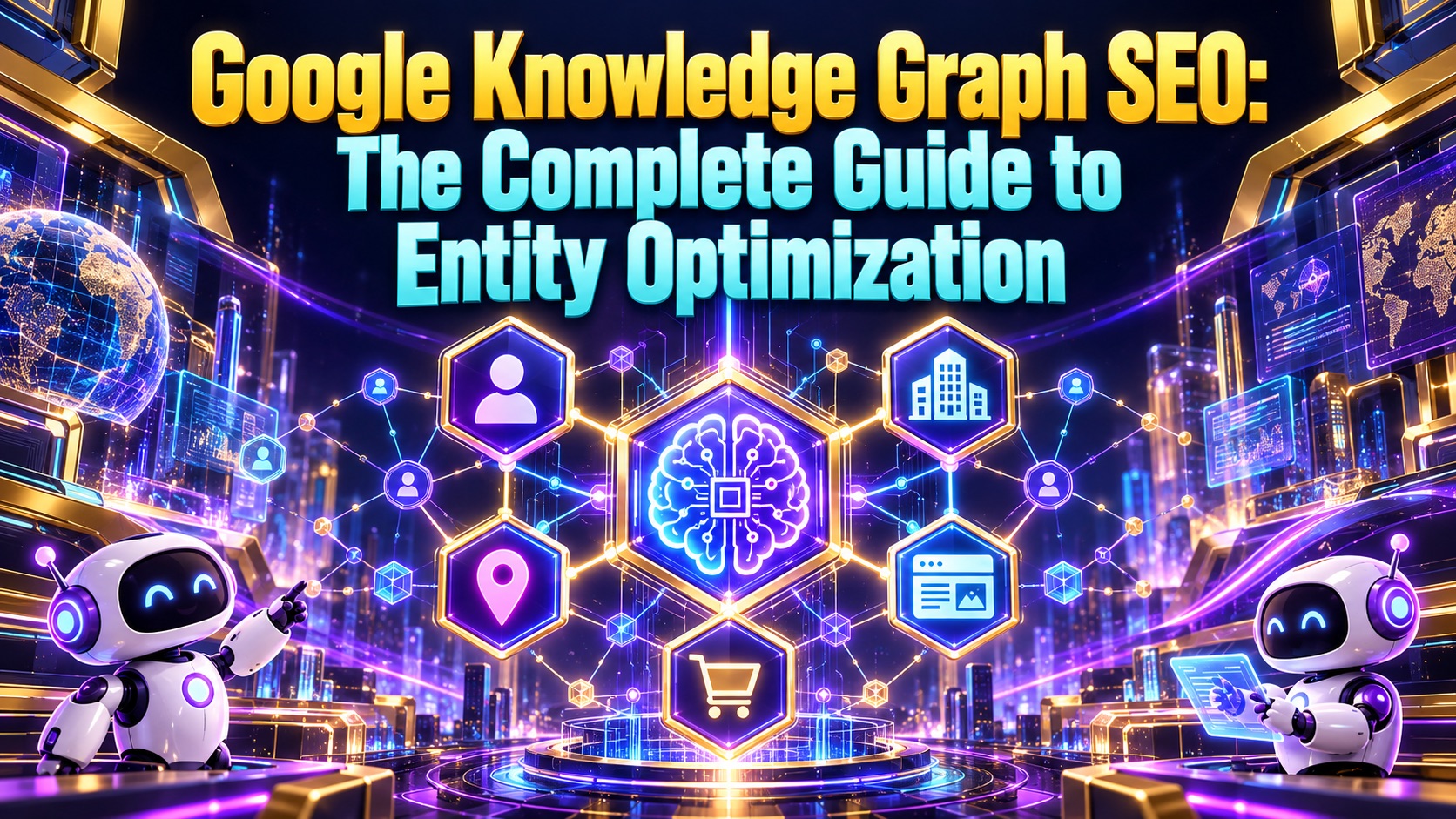
Google Knowledge Graph SEO: The Complete Guide to Entity Optimization
Obsah článku
- Understanding Google Entities and Knowledge Panels
- How Semantic Search Drives Knowledge Graph SEO
- Why Entity Recognition Builds Search Engine Trust
- 5 Practical Steps to Optimize for Entities
- 1. Add Structured Schema Markup
- 2. Keep Your Google Business Profile Accurate
- 3. Connect to Open Reference Databases
- 4. Maintain Consistent Brand Citations
- 5. Write Topic-Focused Content
- Tools to Track Entities and Knowledge Panels
- Conclusion
SEO isn’t just about matching keywords anymore. These days, ranking well means mastering Knowledge Graph SEO — helping Google actually understand who you are, the real concepts, organizations, and people behind your website. When you build your online presence around clear, recognizable entities, your site starts to look less like just another page and more like a genuine authority in your industry.
Understanding Google Entities and Knowledge Panels
Google keeps a giant, connected database of facts about businesses, people, and places. Rather than just reading the words on a page , its algorithms group these facts together into “entities” and figure out how they all relate to each other.
Knowledge Panels are the information boxes that appear on search result pages when Google recognizes a verified entity. This panel pulls confirmed data like logos, founders, and contact details from authoritative sources. Getting a panel proves your business is a trusted entity rather than just another web page.
How Semantic Search Drives Knowledge Graph SEO
Semantic search focuses on context and intent rather than exact phrasing. Algorithms evaluate surrounding words to clear up confusion between similar terms, ensuring users get the exact answers they need.
As part of this, every entity Google recognizes gets its own unique ID in its database. Google is constantly cross-checking your website, social channels, and news mentions to piece together a fuller picture of your brand. The more your online presence lines up with solid Knowledge Graph SEO practices, the easier it is for Google to trust and understand your business.
Why Entity Recognition Builds Search Engine Trust
Search engines prioritize content from creators with proven Experience, Expertise, Authoritativeness, and Trustworthiness (E-E-A-T). Algorithms use entity connections to verify who wrote a page and whether that author holds real credentials.
When an author or company is recognized as an entity and linked to official publications, their content earns higher baseline trust. Unverified brands struggle to rank because search crawlers cannot easily confirm their real-world credibility. Clear entity mapping solves this by providing direct proof of your expertise.
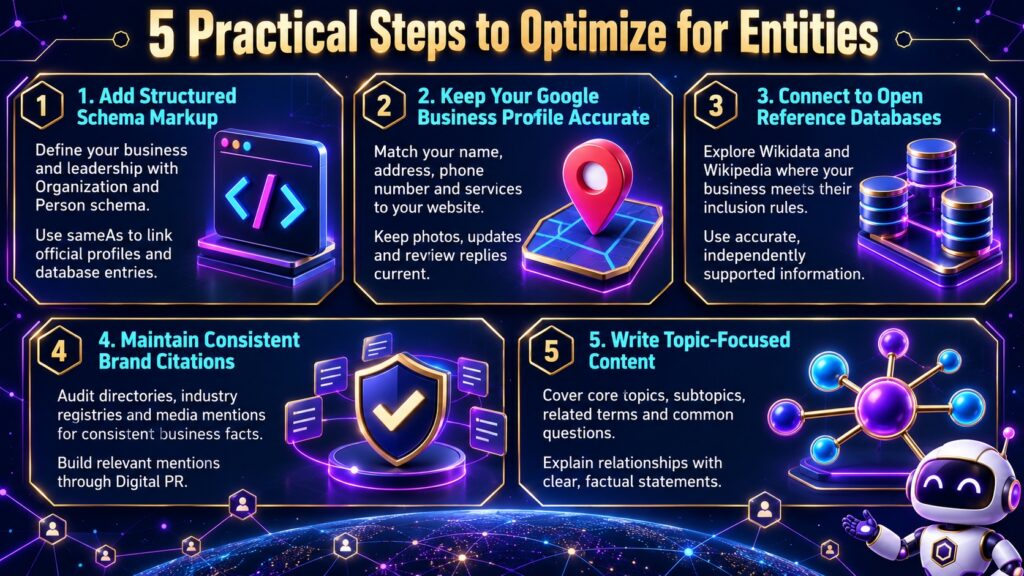
5 Practical Steps to Optimize for Entities
1. Add Structured Schema Markup
Schema markup acts as code that tells search crawlers exactly what your content means. Use Organization and Person schema to define your business and leadership team clearly. Include sameAs properties linking directly to your official social profiles and database entries so search engines know those pages belong to you.
2. Keep Your Google Business Profile Accurate
Local entity optimization relies heavily on your Google Business Profile. Make sure your business name, address, phone number, and primary services match your website. Upload regular updates, photos, and review replies to signal active real-world operations.
3. Connect to Open Reference Databases
Platforms like Wikipedia and Wikidata serve as primary trust sources for search engines. Creating a verified entry on Wikidata assigns your business a global data ID, which speeds up entity recognition. Earning mentions or links inside existing Wikipedia articles also adds massive semantic authority.
4. Maintain Consistent Brand Citations
Inconsistent business details confuse search crawlers and lower your trust score. Audit online directories, industry registries, and media mentions to ensure your business facts remain identical everywhere. Support this with Digital PR to earn mentions on respected news sites, proving your brand’s prominence.
5. Write Topic-Focused Content
Shift your strategy from target keywords to complete topic coverage. Map out main concepts along with their sub-topics, related terms, and common user questions. Write clear, factual statements that define how concepts relate, positioning your site as an authoritative subject hub.
Tools to Track Entities and Knowledge Panels
Specialized software helps you monitor how search engines see your brand structure:
Google Knowledge Graph Search API: Checks if your entity exists in Google’s database and reveals its unique ID.
Inlinks: Scans website pages for recognized entities and automates schema creation.
Kalicube Pro: Tracks and helps fix Knowledge Panel errors across your brand ecosystem.
Diffbot: Uses machine learning to show how web crawlers extract facts from your pages.
Schema App: Manages and deploys structured data across large sites easily.
Conclusion
Succeeding in modern search requires organizing your digital facts into clear concepts. By applying smart Knowledge Graph SEO, keeping your business data consistent, and covering subjects thoroughly, you secure your site’s authority for both current search results and future AI discovery systems.

Zakladateľ agentúry Market. Brand. Grow. Taktiky, o ktorých píšem, najprv testujem na vlastných projektoch — od účtu so 450 000 sledovateľmi po web zo 4. strany Google na prvú.
Všetky články autora →Súvisiace články
Meta AI SEO: Optimizing Content for Facebook and Instagram’s Answer Engine
Obsah článkuHow Meta AI Finds and Uses InformationSearch Engines and Meta AI SEOPractical Meta AI SEO TacticsPut the Main Answer FirstKeep Your…
12. 10. 2026 · Peter Terlanda
Google AI Overviews SEO: How to Get Cited in AI Answers
Obsah článkuWhat Are Google AI Overviews? What This Shift Really Means for Your Clicks and Visits How to Earn a Spot Inside the Answer…
24. 9. 2026 · Peter Terlanda
Google Gemini SEO: How to Rank Your Content in Gemini Answers
Obsah článkuUnderstanding Gemini SEO and Its connection to Google’s Algorithms Solid SEO Habits Still Drive Gemini SEO Success How to Get Your Content Cited…
17. 9. 2026 · Peter Terlanda Bezplatná konzultácia
Radšej by ste to nechali na odborníka?
15 minút s autorom článku — prejdeme váš web a odídete s konkrétnymi návrhmi. Bez záväzku.
Chcem bezplatnú konzultáciu →